
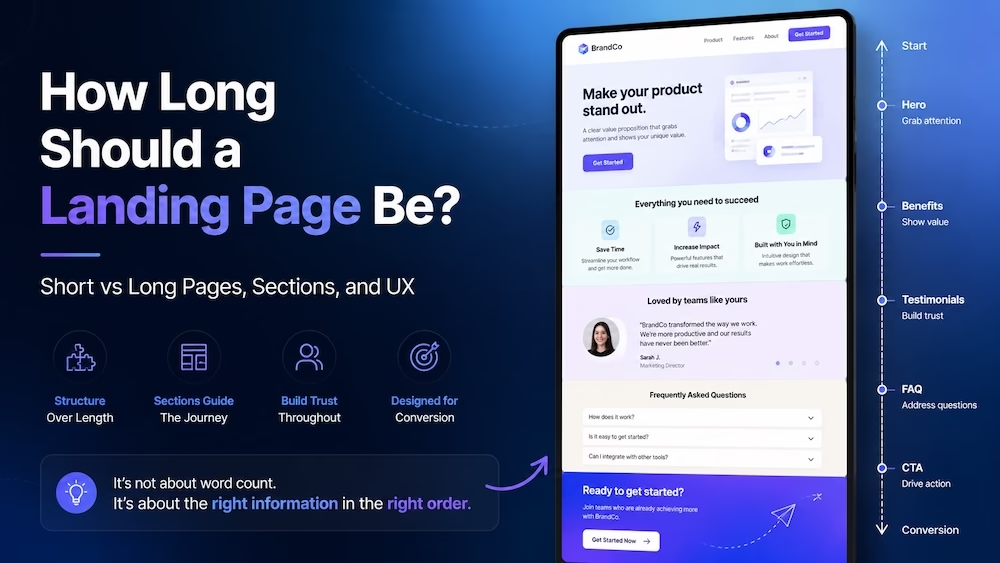
How Long Should a Landing Page Be? Short vs Long Pages
6/30/2026
Read More →
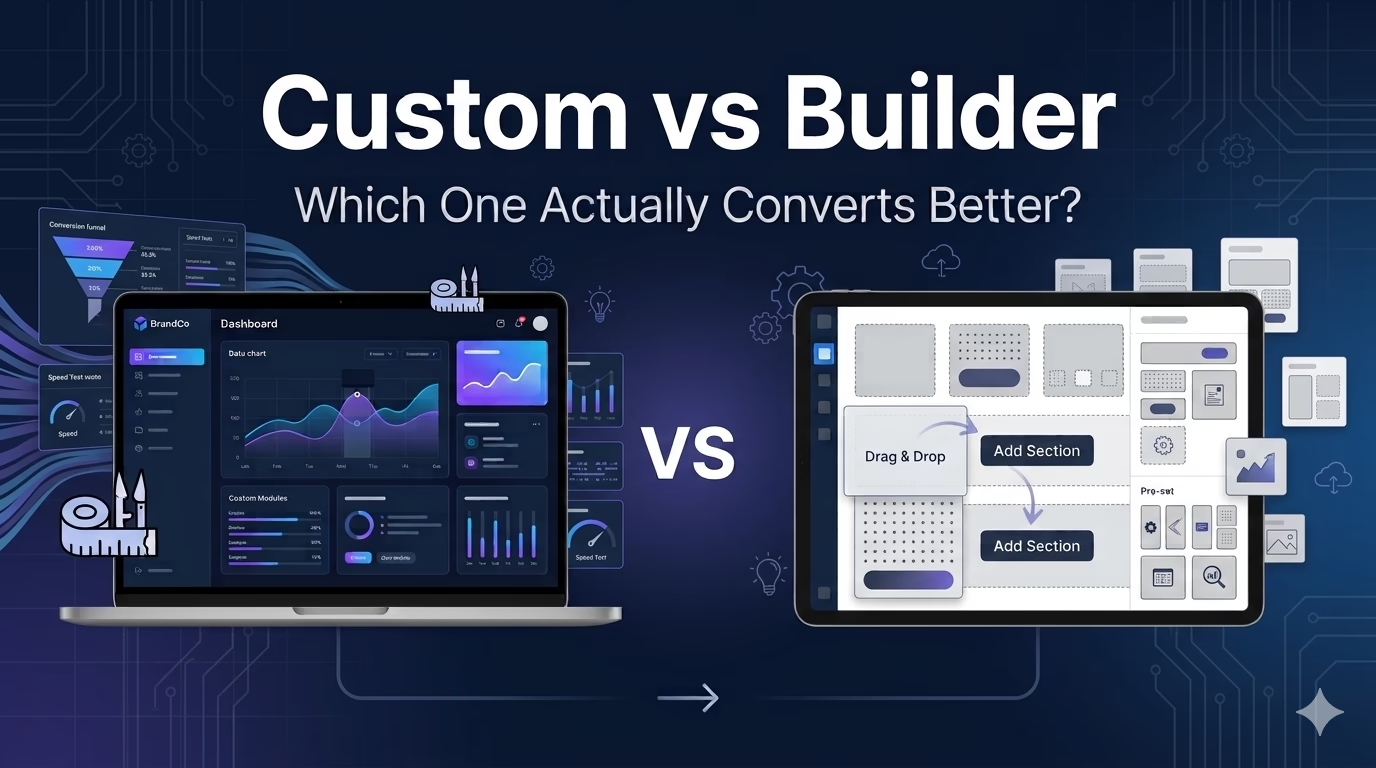
The question is rarely about the actual code. It is about money and risk.
Business owners ask whether they should build a custom website or use a builder like Wix, Squarespace, or Webflow. The underlying question is always the same: “Will I get more customers if I spend more money on this?”
The short answer is no. Spending more money does not guarantee more conversions. The platform does not convert visitors. The content, the user flow, and the speed of the site convert visitors.
But the platform does determine what you are able to build. And that constraint is where the real difference lives.
A website builder converts better for simple, transactional offers where speed to market matters more than brand differentiation. A custom website converts better for businesses with complex sales cycles, high average order values, or specific user journey requirements that builders cannot accommodate.
The conversion difference is not about the framework. It is about how much control you have over the visitor experience. Builders give you templates. Custom gives you a blank canvas.
If your offer fits neatly into a template, the builder will convert just as well as a custom site and cost a fraction of the price. If your offer requires a specific sequence of information, a unique interface, or a tailored checkout flow, the builder will hold you back and the custom site will outperform it.
Here is the breakdown of what each platform actually enables for conversion optimization.
| Factor | Website Builder (Wix, Squarespace) | WordPress + Page Builder (Elementor) | Fully Custom Built |
|---|---|---|---|
| Load Speed (Potential) | Moderate to Slow | Moderate | Fast to Very Fast |
| Design Flexibility | Limited to templates | High | Unlimited |
| Mobile Responsiveness | Decent out of the box | Requires manual testing | Fully controllable |
| Conversion Tracking Setup | Limited native tools | Good with plugins | Unlimited (full data layer) |
| User Flow Customization | Rigid | Moderate | Completely flexible |
| Maintenance Required | Low | High (updates, plugins) | High (hosting, security) |
| Time to Launch | Days | Weeks | Months |
| Cost (3 Year TCO) | $1,000 - $2,000 | $3,000 - $6,000 | $15,000 - $40,000 |
A builder is a closed ecosystem. The hosting, the content management, and the design tools all come from one provider. You pick a template. You drag and drop elements. You publish.
The advantage is simplicity. You do not need a developer to change a headline or upload a new image. The disadvantage is that you are working within the limitations the builder sets. If the template does not have a specific layout, you either hack it with custom code or you live without it.
Most builder sites look similar. That is not necessarily a bad thing. Familiarity builds trust. Visitors expect a certain pattern for a restaurant menu page or a service booking form. Breaking that pattern can actually hurt conversions.
The problem arises when you try to do something the builder was not designed for. Complex ecommerce flows, multi-step calculators, custom pricing tables, or conditional logic forms are difficult or impossible to implement well. You end up using third-party widgets that slow down the site and look out of place.
A custom website is built from the ground up for your specific business. The code is written for your use case. The hosting is managed separately. The design is unique to your brand.
The advantage is complete control. You can build exactly what you envision. Every element serves a specific purpose. The user flow is designed to move the visitor from awareness to action without distraction.
The disadvantage is cost and time. Custom sites take months to build and cost significantly more. You need a developer to make changes. If your developer is unavailable, you are stuck. You also need to manage hosting, security, and backups yourself.
Custom sites can be faster, but only if the developer knows what they are doing. A poorly built custom site is slower than a builder site and costs ten times more.
Builders win for businesses that just need a presence and a single action.
A local service provider like a plumber, a dentist, or a real estate agent has a simple conversion goal. The visitor wants to call, book an appointment, or fill out a contact form. That does not require a custom interface. A clean template with a prominent phone number and a form works perfectly.
Builders also win for businesses that need to launch fast. If you have a pop-up shop, a temporary campaign, or a new product line, you cannot wait three months for development. You need something up in three days. The extra conversion lift from a custom site is not worth the delay.
The data from several platform studies shows that builder sites convert at similar rates to custom sites for low-consideration offers. If the visitor already knows what they want, the platform does not matter. The form works or it does not. The button loads or it does not.
Builders have also improved significantly in recent years. Webflow, in particular, blurs the line between builder and custom. It allows for complex animations and responsive layouts that were previously only possible with custom code. For many businesses, Webflow is the sweet spot between cost and capability.
Custom wins when the conversion journey is non-standard.
Consider a B2B SaaS company. The visitor needs to see a demo, understand the pricing structure, compare plans, and then decide to start a trial. Each stage requires a specific layout. The pricing table needs to highlight the most profitable plan. The demo request form needs to collect the right qualification data before passing it to sales.
A builder can do this, but it will require multiple plugins and hacks. The plugins will conflict. The page will slow down. The data will not pass cleanly to the CRM. The result is a frustrating experience for the visitor and a broken process for the sales team.
Custom also wins when brand differentiation is the conversion lever. If your design is part of your value proposition, a template undermines that value. Premium products and services often need premium visuals to justify the price. A Squarespace template does not communicate exclusivity. A bespoke design does.
The conversion lift from custom often comes from the cumulative effect of dozens of micro-improvements. A faster load time adds two percent. A better information hierarchy adds three percent. A tailored checkout flow removes friction and adds five percent. These small gains compound to a significant difference over time.
Speed is the most measurable conversion factor. Google’s research shows that a one-second delay in mobile load time reduces conversions by up to twenty percent. Every second matters.
Builders struggle with speed because they load unnecessary code. They include scripts for features you are not using. They rely on third-party CDNs that may be slow in certain regions. They also have limited server configurations.
Custom sites can be optimized aggressively. You only load the code you need. You choose the hosting provider. You configure caching and compression at the server level. You can achieve near-instant load times.
But a custom site is only as fast as the developer who builds it. I have seen custom sites that load in under a second. I have also seen custom sites that take eight seconds to render because the developer used massive images and unoptimized JavaScript. The platform does not guarantee speed. The execution does.
This is where the decision gets harder.
Builders require almost no maintenance. The provider handles security updates, server patches, and backups. You pay a monthly fee and the site stays online. If something breaks, the provider fixes it.
Custom sites require ongoing maintenance. The hosting needs to be monitored. Security patches need to be applied. The codebase needs to be updated when dependencies change. If you stop paying for maintenance, the site slowly degrades until it eventually breaks.
The total cost of ownership for a custom site is higher than the initial build cost. Factor in annual maintenance, hosting, and emergency fixes. Over five years, a custom site can cost three to four times the initial build price.
That is not an argument against custom sites. It is an argument for being realistic about your budget and your team’s capacity to manage a technical asset. If you cannot commit to maintenance, stick with a builder.
Stop asking which platform is better. Start asking which platform fits your specific situation.
| If this describes your business… | …then choose this platform |
|---|---|
| Simple offer, one clear CTA, local audience, low budget | Builder (Wix/Squarespace) |
| Content-heavy, blog-driven, moderate budget, existing tech comfort | WordPress + Builder |
| Unique UX, complex data flows, high AOV, technical team in-house | Custom Built |
| Designer-driven, moderate complexity, no coding, need animation control | Webflow (Builder/Custom hybrid) |
| Ecommerce with many SKUs, basic checkout, standard product pages | Shopify |
| Ecommerce with custom pricing, subscriptions, complex bundling | Custom Built |
Regardless of the platform, three factors determine your conversion rate.
Clarity. The visitor needs to understand what you are offering within three seconds. A custom site cannot fix confusing copy. A builder site with clear copy will outperform a custom site with vague messaging every time.
Trust. The visitor needs to believe you can deliver. Social proof, guarantees, security badges, and professional imagery build trust. These are content decisions, not platform decisions.
Friction. The visitor needs to complete the action without obstacles. Remove unnecessary form fields. Simplify the checkout. Make the button easy to find. A custom site can reduce friction through tailored flows. A builder can reduce friction by keeping the template simple and not adding unnecessary widgets.
Platform choice matters, but it matters less than these three factors. A well-built builder site with excellent clarity, trust, and low friction will convert better than a poorly built custom site.
Do not build a custom website because you think it will magically increase conversions. Build a custom website because you have a specific user journey that requires custom logic, a unique design that differentiates your brand, or a scale that demands maximum performance.
If you do not have any of those requirements, save your money and launch on a builder. The money you save can be spent on the things that actually drive conversions: better copy, better imagery, and better traffic.
The platform is a tool. The conversion is the result of how you use it. Choose the tool that lets you execute your strategy without getting in the way. For most small businesses, that tool is a builder. For agencies, custom projects, and high-growth startups, that tool is custom code. Both approaches work. The mistake is picking one without understanding the trade-offs.